
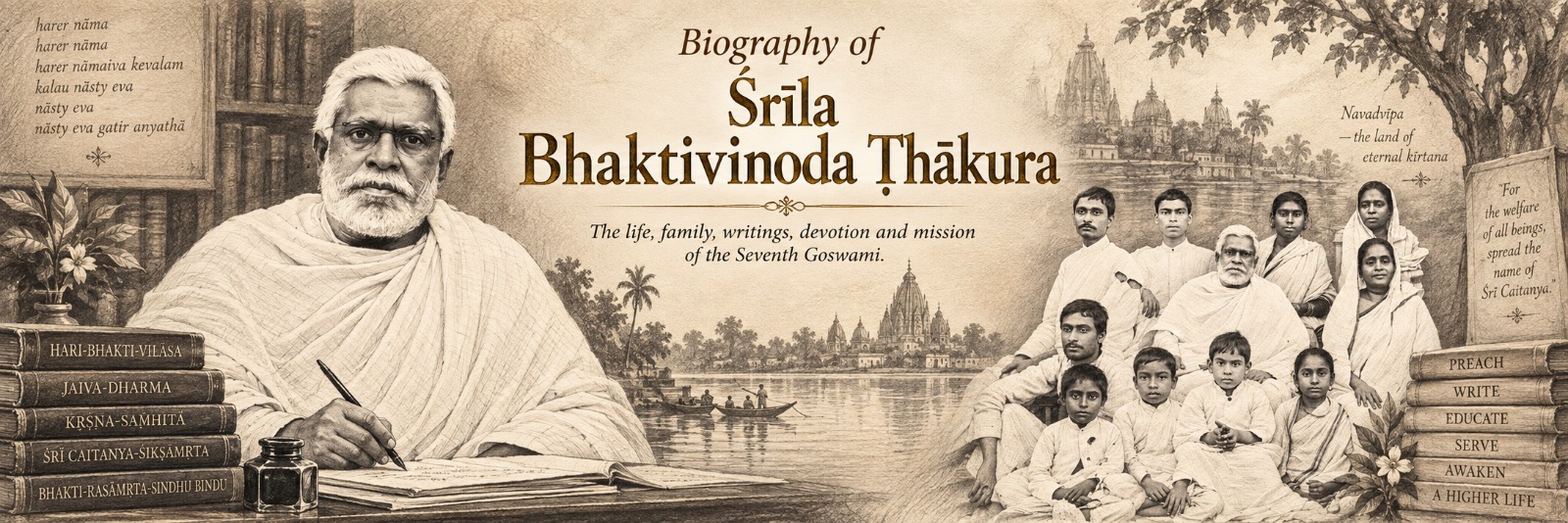
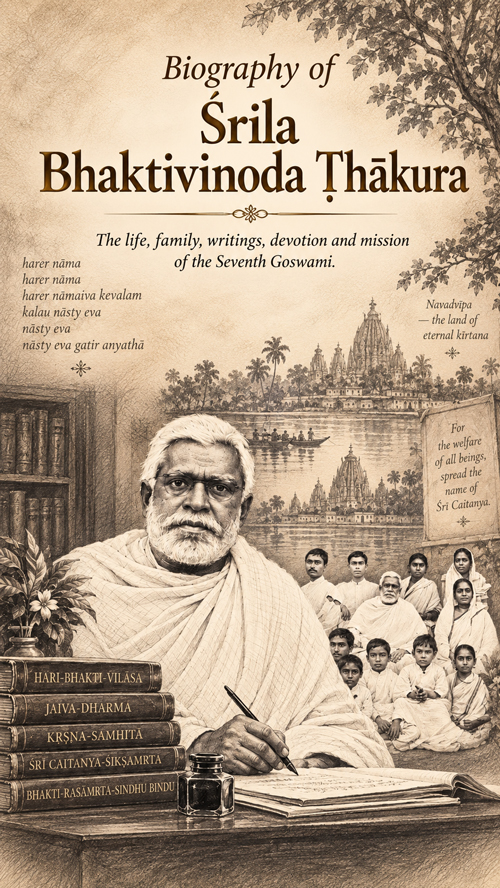
Life Journey
Explore the beautiful journey of Srila Bhaktivinod Thakur divided into key phases of his life.
Born into a Changing Bengal
(1838–1852)
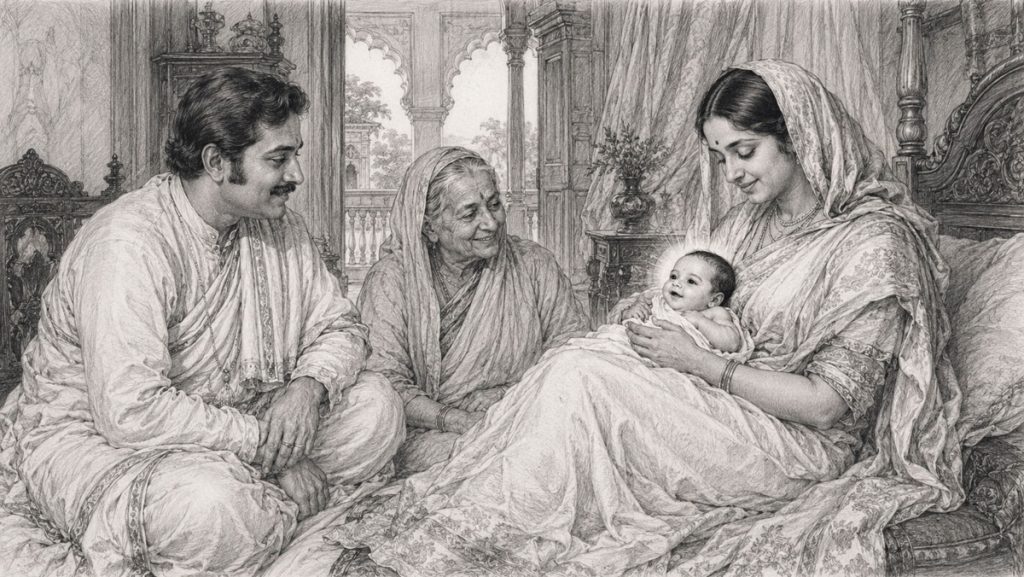
Birth, Family, Childhood & the First Lessons of Impermanence
Kedarnath Datta was born in 1838 into a respected Bengali family during a period of profound transition. Bengal was still deeply rooted in traditional social and religious life, yet the forces of colonial administration, English education, new forms of printing and intellectual debate were rapidly reshaping the environment. The young Kedarnath therefore belonged to two worlds from the beginning: the inherited world of family, village, custom and sacred memory, and the emerging modern world that would later demand enquiry, comparison and personal judgement.
Saptam Goswami treats these early years in a distinctly human way. It does not rush to present the child as an already completed saint. Instead, the narrative lingers over family members, household concerns, health, local relationships, economic changes and the uncertainties that surrounded ordinary life. This makes the later Bhaktivinoda more understandable. His mature reflections on worldly impermanence were not merely theoretical conclusions; they grew from experiences in which security could disappear, family circumstances could change and death could enter suddenly into the life of a household.
The environment of his childhood also gave him a close familiarity with Bengali rural culture. Village society, devotional habits, popular religion, domestic ritual and the social character of the period formed part of the atmosphere from which he emerged. Yet even in these surroundings the book presents him as unusually observant. He notices people, questions behaviour and gradually develops the mental independence that would later become one of his defining characteristics.
For a website, this first phase should feel intimate rather than monumental. Visitors should meet Kedarnath before they meet the famous acharya. The point is to show that the future Bhaktivinoda was formed through real human experiences: family affection, uncertainty, education, grief and the early discovery that worldly arrangements are never permanent.
This phase also helps explain why his later spiritual teaching could speak to householders. He knew from within the pressures and vulnerabilities of family life. He did not approach the world as an abstract philosopher standing outside it; he learned first through participation in it.
Did You Know ?
Bhaktivinoda was born in an era when old Bengal and the new colonial-modern Bengal existed side by side. His later life would become one of the most important religious responses to that transition.
Calcutta Opens a New World
(c. 1852–1856)
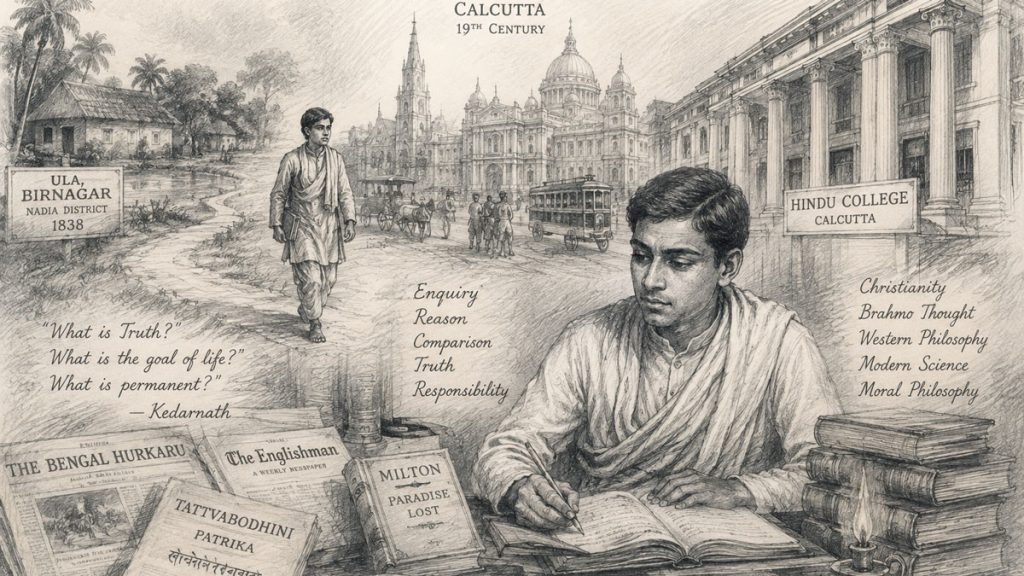
Student Life, English Education & the Awakening of a Modern Mind
The move into the orbit of Calcutta opened a much wider intellectual world for Kedarnath. The city was becoming one of the principal centres of modern education and public debate in British India. English literature, new schools, newspapers, Christian missionary arguments, Brahmo reform, social criticism and Western philosophy were all part of the atmosphere. For a thoughtful young Bengali, this environment could unsettle inherited assumptions very quickly.
Kedarnath’s education should not be described simply as the accumulation of academic knowledge. What mattered most was the habit of enquiry. He learned to compare ideas, examine claims and take intellectual responsibility for what he believed. This habit would later distinguish Bhaktivinoda’s theological writing. He did not merely repeat inherited formulas; he repeatedly tried to explain why a doctrine mattered, how it related to human experience and how it could be communicated to readers shaped by modern education.
Saptam Goswami’s later chapters make clear that this intellectual formation never disappeared. Even after his firm commitment to Gaudiya Vaishnavism, Bhaktivinoda remained capable of reading widely and addressing competing viewpoints. Christianity, Brahmo thought, modern moral philosophy and European intellectual categories did not simply frighten him away from tradition. They forced him to define more carefully what he found true and complete in the teachings of Sri Chaitanya Mahaprabhu.
That is why this student phase is essential for the website. Without it, Bhaktivinoda can appear as though he moved directly from inherited Bengali religion into mature Vaishnava conviction. The book suggests a more interesting journey: he first became a questioning modern mind, and only later did that mind find spiritual certainty.
The future acharya’s ability to speak to both traditional devotees and educated modern readers was therefore prepared here. His later bridge-building role between Sanskritic Vaishnava theology and nineteenth-century public discourse begins with this period of education and intellectual expansion.
Did You Know ?
Bhaktivinoda’s later success as a religious author depended partly on his ability to understand the mental world of educated nineteenth-century readers rather than merely condemning it from outside.
Into the World
(c. 1856–1866)
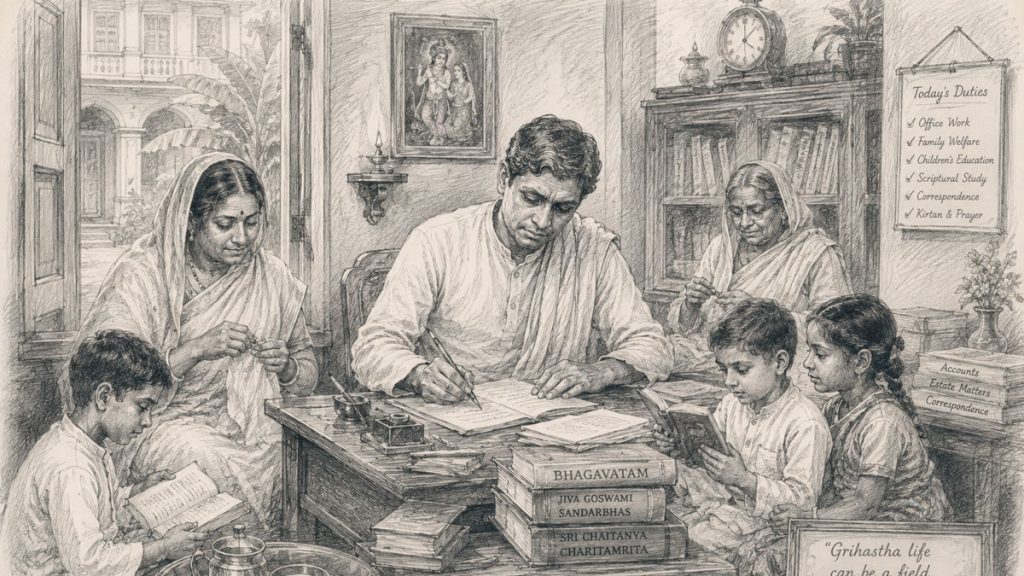
Marriage, Household Responsibility & the Discipline of Ordinary Life
Bhaktivinoda Thakur’s biography is especially powerful because his spiritual life developed within the responsibilities of a householder. Kedarnath married, entered family life, faced practical financial questions, travelled, cared for relatives and experienced the unpredictable demands that come with maintaining a household. The book does not erase these concerns once his spiritual interest grows; rather, they remain part of the environment in which his character matures.
This is one of the points where Saptam Goswami feels particularly relevant to modern readers. The text repeatedly shows that devotion did not begin after all difficulties had disappeared. Kedarnath’s life contained simultaneous pressures. Professional duty had to be fulfilled. Family members needed attention. Illness and uncertainty remained possible. Money was sometimes a concern. Yet the search for truth continued within these conditions.
The mature Bhaktivinoda would eventually embody the principle that grihastha life need not be spiritually second-rate. Household responsibilities can become part of devotional discipline when they are performed with integrity and centred upon Krishna. This is not romanticised in the book. Family life is shown as demanding, and precisely for that reason it becomes a field in which patience, responsibility, compassion and detachment can be cultivated.
For the website, this section should avoid reducing marriage and family to a small biographical footnote. It is a major part of his spiritual significance. Bhaktivinoda’s example later gave confidence to educated householders who wanted to take bhakti seriously without pretending that family obligations did not exist.
His later astonishing productivity also becomes more meaningful when seen against this background. The author, magistrate, preacher and organiser was still a husband and father. His life therefore does not present spirituality as an alternative to duty, but as the principle that gradually gives duty a higher purpose.
Did You Know ?
One of the most remarkable features of Bhaktivinoda’s life is not that he became spiritual after leaving worldly obligations, but that deep devotion grew while those obligations remained.
The Magistrate Who Would Become a Mahajana
(c. 1866–1874)
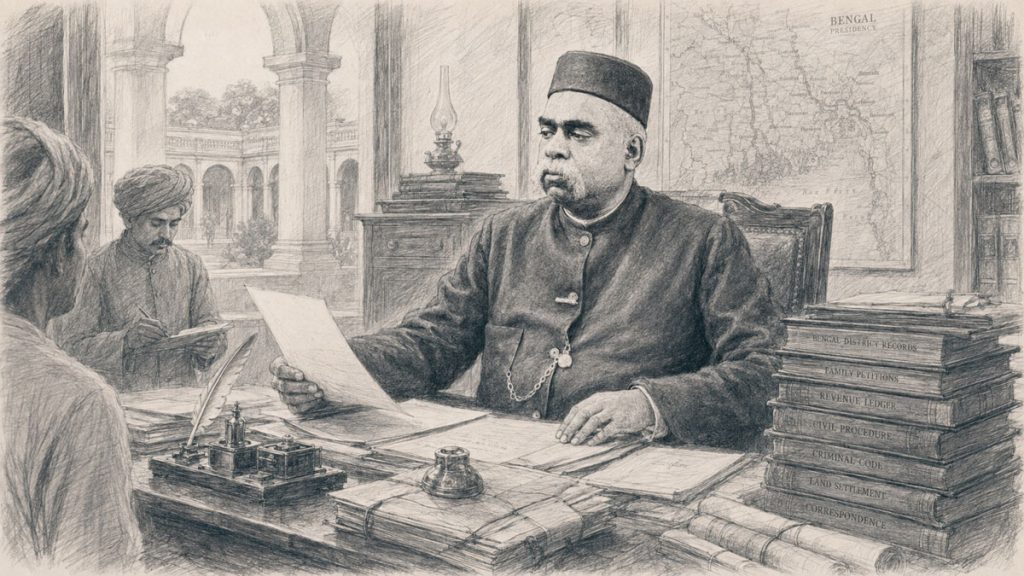
Government Service, Justice, Administration & Moral Responsibility
Kedarnath Datta’s public career placed him in positions of real responsibility. Saptam Goswami presents him not as a passive employee of the colonial system, but as an educated and capable official required to deal with administration, disputes, education, local society, public welfare and difficult decisions. These years widened his understanding of how institutions work and how ordinary people are affected by authority.
This professional experience is important for understanding his later religious organisation. Bhaktivinoda knew how to manage correspondence, records, public communication and institutional responsibilities. He understood that good intentions alone do not create sustainable public work. Organisation requires discipline, accountability, clarity and the ability to deal with human complexity. Those qualities later became visible in his devotional mission.
At the same time, public success did not satisfy the deeper dimension of his personality. The narrative increasingly suggests a tension between competence in worldly affairs and the recognition that worldly achievement cannot answer the final questions of life. Kedarnath could perform his duties well, but he could not reduce existence to career, status or administrative success.
This is the period in which duty and detachment begin to coexist more consciously. The future Bhaktivinoda did not reject responsible work; he tried to perform it with integrity while refusing to make it the ultimate centre of his identity. That distinction is essential for understanding the spiritual philosophy that later emerges from his life.
For web presentation, this phase can be visually strong: government documents, period maps, magistrate imagery, schools, court architecture and nineteenth-century administrative Bengal. The section should communicate that the man who later became a major Vaishnava acharya was thoroughly experienced in the structures of modern public life.
Did You Know ?
His public career exposed him to law, education, administration and social problems. Those experiences later strengthened his ability to organise devotional work in practical, modern forms.
The Turning Point: Meeting Sri Chaitanya
(c. 1868–1880)
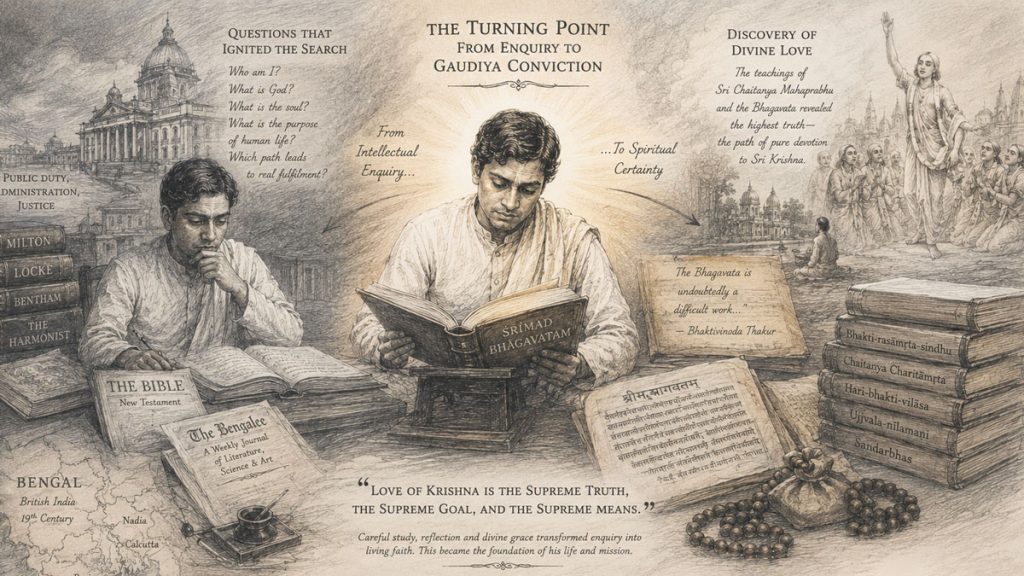
Religious Search, Bhagavata Study & the Formation of Gaudiya Conviction
Kedarnath’s movement toward Gaudiya Vaishnavism was not presented as a simple inheritance of family religion. He passed through a serious period of enquiry. Different religious systems, moral teachings and philosophical arguments were examined. The question was not merely which tradition was socially familiar, but which vision of God, the soul and human purpose could withstand both reason and spiritual experience.
The teachings of Sri Chaitanya Mahaprabhu gradually became decisive. The devotional theology of the Bhagavata, the centrality of Krishna, the transformative power of the Holy Name and the conception of divine love gave Kedarnath a framework that was intellectually satisfying and existentially complete. The change was gradual but profound. He did not simply add Vaishnava practices to an unchanged worldview; his understanding of life itself was reorganised.
Saptam Goswami’s later chapters preserve English-language discussions of the Bhagavata and of Chaitanya’s philosophy. These passages are significant because they show the mature Bhaktivinoda explaining a traditional sacred text to readers who might approach it with modern intellectual hesitation or inherited prejudice. He acknowledges difficulty rather than avoiding it, yet insists that careful study reveals depth.
The transformation from Kedarnath the religious seeker to Bhaktivinoda the committed Vaishnava therefore involved both heart and intellect. Reading became attraction. Attraction became conviction. Conviction became disciplined practice. And disciplined practice eventually became an outward mission to communicate the same discovery to others.
For the website, this should be treated as the spiritual centre of the entire biography. Earlier sections explain the man who was searching; later sections explain what he did after finding his path. This phase is the hinge between the two halves of his life.
“The Bhagavata is undoubtedly a difficult work…”
Did You Know ?
Bhaktivinoda’s faith was strengthened through study and reflection. His later writings repeatedly demonstrate that he did not consider reason and devotion enemies.
When the Pen Became Seva
(1870s–1890s)
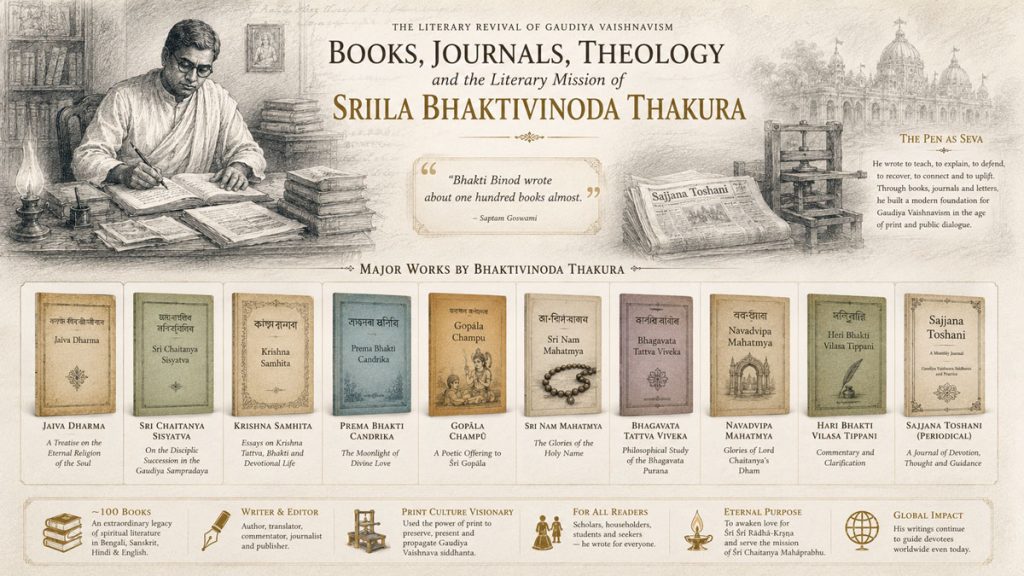
Books, Journals, Theology & the Literary Revival of Gaudiya Vaishnavism
Once Bhaktivinoda’s Gaudiya conviction matured, writing became one of his principal forms of service. He understood that a religious tradition cannot remain strong if its philosophy is inaccessible, its history is confused and its teachings circulate only within a narrow circle. The modern world was being shaped by books, newspapers, journals and public debate. Gaudiya Vaishnavism, he believed, needed to speak through these same channels without losing its spiritual depth.
His literary activity therefore had several functions at once. It taught doctrine, defended devotional conclusions, explained difficult concepts, recovered forgotten or neglected material, addressed contemporary intellectual questions and gave ordinary readers a language in which to understand bhakti. This was not scholarship for prestige. The pen became seva.
Saptam Goswami places this literary labour alongside his professional and family obligations. That combination is part of the astonishment surrounding Bhaktivinoda’s life. He wrote extensively without having the external simplicity of a person free from all worldly responsibilities. The testimony reproduced near the end of the book marvels that he produced an extraordinary number of books while serving as an officer, magistrate and family man.
The journal Sajjana Toshani became another important part of this work. Periodical publication allowed Vaishnava teaching to become a living conversation rather than only a collection of old texts. Questions could be addressed, ideas clarified, communities connected and current issues discussed through a devotional lens.
For the website, this section should include a visual grid of major works, manuscript or print imagery and a short explanation of why print culture mattered. Bhaktivinoda did not merely write many books; he helped create a modern literary infrastructure for Gaudiya Vaishnavism.
His achievement also changed the intellectual reputation of the tradition. By presenting theology systematically and engaging educated readers, he helped demonstrate that Gaudiya Vaishnavism possessed philosophical depth, historical self-awareness and a serious body of literature.
“Bhakti Binod wrote about one hundred books almost.”
Did You Know ?
Bhaktivinoda’s literary mission was not separate from preaching. Books and journals were themselves instruments for carrying Mahaprabhu’s message beyond the immediate reach of a speaker.
Taking Bhakti Beyond the Temple
(1880s–1890s)
Nama-Hatta, Congregational Outreach & the Organisation of Devotional Life
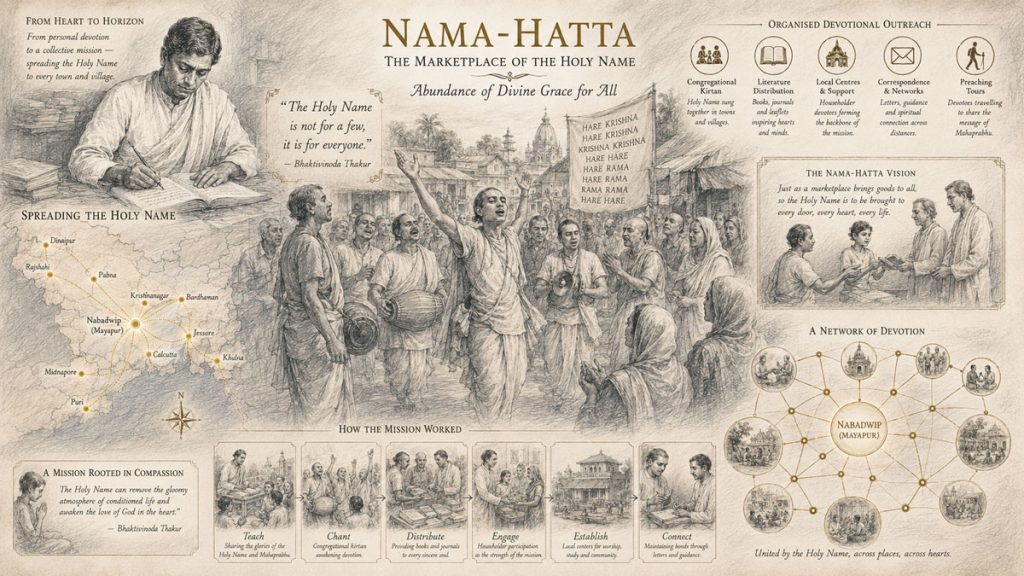
Bhaktivinoda’s mature vision was not limited to personal bhajan or literary production. He wanted devotional life to become accessible, organised and active among ordinary people. The Holy Name should be heard in homes, villages, towns and public gatherings, not remain restricted to a small religious elite.
This wider vision became associated with organised forms of congregational outreach and the idea of Nama-Hatta, the ‘marketplace of the Holy Name.’ The metaphor is powerful because it expresses abundance rather than scarcity. Spiritual wealth is not to be guarded by a few; it is to be distributed. Devotees, local gatherings, travelling preachers, literature, household participation and networks of communication could all cooperate in this distribution.
The organisational side of Bhaktivinoda’s personality becomes especially important here. His years in administration had trained him to think practically. A movement requires communication, dependable people, regular activity and a way for local communities to remain connected. His devotional mission therefore combined spiritual inspiration with organisational intelligence.
This approach anticipated methods that would later become standard in modern Gaudiya movements: systematic preaching tours, printed literature, local centres, networks of household supporters, correspondence and a clear emphasis on congregational participation. Bhaktivinoda did not invent bhakti, but he helped build forms through which an old tradition could move effectively in a new social environment.
For a website, this section works well with maps, network graphics and historical illustrations of village kirtan or preaching. The visitor should feel that the biography is expanding outward: the seeker has become a communicator, and personal faith has become a social mission.
The deeper theological point is equally important. Outreach was not merely expansion for its own sake. It rested on the conviction that the Holy Name and Mahaprabhu’s message belong to all sincere souls, not only to those born into a particular social or religious category.
Did You Know ?
Many of the tools later associated with worldwide Gaudiya preaching—books, travelling teachers, congregations, correspondence and organised centres—are already visible in Bhaktivinoda’s missionary outlook.
Finding Mahaprabhu’s Lost Birthplace
(Late 1880s–1890s)
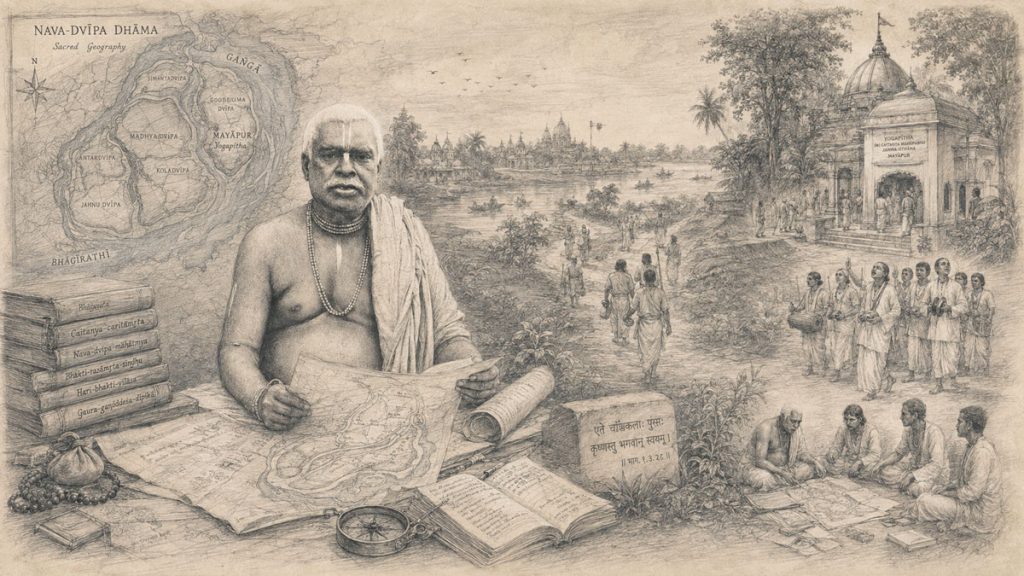
Navadvipa, Mayapur, Yogapitha & the Recovery of Sacred Geography
Among Bhaktivinoda Thakur’s most far-reaching contributions was his concern with the sacred geography of Sri Navadvipa Dham and the birthplace of Sri Chaitanya Mahaprabhu. By the nineteenth century, historical changes in the river system, settlement patterns and local memory had complicated the identification of ancient sites. For Bhaktivinoda, this was not merely an antiquarian puzzle. Sacred geography carries theology, memory and pilgrimage.
The search for Mahaprabhu’s appearance place therefore became part of a wider spiritual recovery. Navadvipa was not simply a town associated with an important saint; it was understood as a dham, a sacred landscape whose places were connected with the pastimes of Sri Chaitanya. To restore knowledge of that landscape was to restore a living devotional map.
Saptam Goswami’s closing movement connects Bhaktivinoda’s mature spiritual life with this recovery of Navadvipa and the growing importance of Mayapur and Yogapitha. The narrative presents a man who combines devotion with investigation: scriptural memory, local tradition, geographical observation and historical reasoning all become relevant.
This is one of the most important sections for a visually rich website because it allows biography, history and place to come together. Old maps, changing river courses, Navadvipa villages, Mayapur landscapes and Yogapitha imagery can make the visitor understand that Bhaktivinoda’s work was not only literary. He helped restore a physical focus for pilgrimage and collective Gaudiya identity.
The later significance of this work is enormous. Mayapur would become one of the principal centres of Gaudiya Vaishnavism in the twentieth century and beyond. The sacred geography that Bhaktivinoda helped recover became inseparable from the later mission of Bhaktisiddhanta Saraswati and the global prominence of Sri Mayapur Dham.
For careful publication, exact claims about individual stages of the identification process should be footnoted and cross-checked against primary historical evidence. But within Saptam Goswami, the broad importance is unmistakable: Bhaktivinoda is portrayed as a central figure in bringing Navadvipa’s sacred identity back into modern Vaishnava consciousness.
Did You Know ?
The revival of Mayapur was not only the recovery of one holy site; it helped re-centre Navadvipa Dham in the devotional imagination of modern Gaudiya Vaishnavas.
A Message Meant for the World
(1890s–1908)
Universal Vision, English Writing & the Crossing of Cultural Boundaries
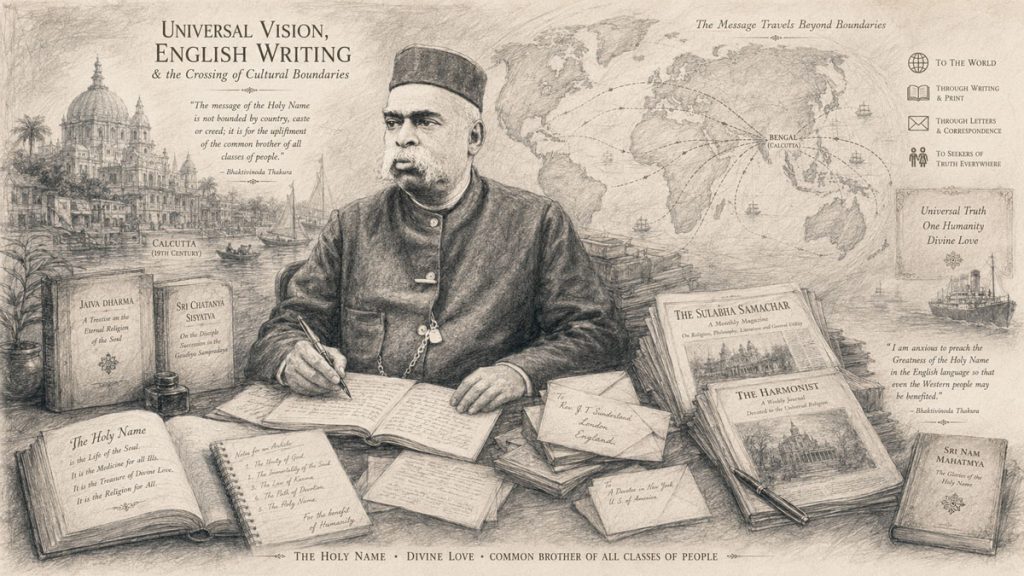
Bhaktivinoda’s vision gradually expanded beyond the boundaries of Bengal. The teachings of Sri Chaitanya Mahaprabhu, as he understood them, were not a regional possession. Divine love, the Holy Name and the theology of Krishna addressed the condition of the soul itself, and therefore possessed universal relevance.
Saptam Goswami preserves several English passages that are highly important for understanding this dimension of his mission. These passages show that Bhaktivinoda was willing to discuss the Bhagavata, Chaitanya’s philosophy and Krishna consciousness in a language accessible to educated readers beyond traditional Bengali Vaishnava circles. English was not merely a sign of education; it became a missionary tool.
His method was also notable for its confidence. He did not present Gaudiya Vaishnavism as a tradition that had to become Western in order to be respected. Instead, he tried to show that its own theological categories could speak intelligently to universal questions: What is the nature of God? What is the soul? What is love? What is the purpose of religion? What kind of devotion transcends sectarian identity?
One striking English phrase reproduced in the book refers to Sri Krishna as the ‘common brother of all classes of people.’ The language is simple, but the implication is far-reaching. Bhakti is not meant to remain imprisoned within caste, class, region or inherited social boundaries.
For the website, this section should feel expansive. Visually, the design can move from Bengal maps to letters, English print, global routes and multilingual text. The message is that Bhaktivinoda’s imagination was already preparing Gaudiya Vaishnavism for a wider world.
This universal outlook would later become one of the defining features of the Gaudiya Math and subsequent international missions. Bhaktivinoda’s contribution was therefore not only to revive a tradition locally, but to articulate why that tradition could meaningfully address humanity beyond its original cultural setting.
“common brother of all classes of people.”
Did You Know ?
Bhaktivinoda’s English writing shows that global outreach was already present conceptually before the later institutional expansion of the Gaudiya Math.
Preparing the Next Generation
(Late 19th–Early 20th Century)
Bhaktisiddhanta Saraswati & the Transmission of a Mission
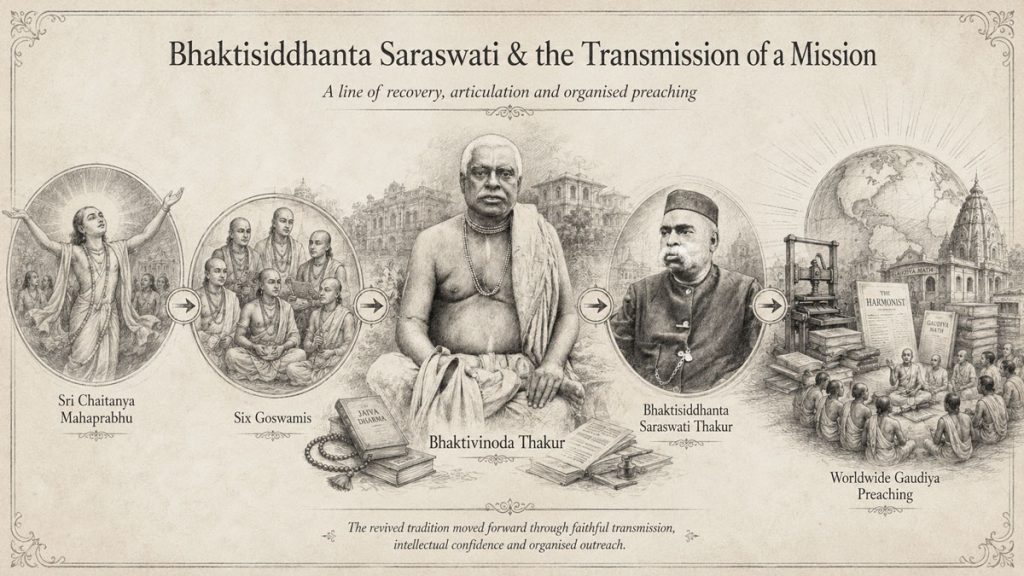
Bhaktivinoda’s historical importance cannot be measured only by what he personally accomplished. A major part of his legacy lies in the devotional culture, intellectual confidence and missionary direction that passed into the next generation. Most important among those who would carry this forward was his son Bimala Prasad Datta, later known as Srila Bhaktisiddhanta Saraswati Thakur Prabhupada.
The relationship is historically significant because Bhaktivinoda had already addressed many of the problems that modern Gaudiya preaching would face. He had strengthened theological literature, used print culture, encouraged organised outreach, revived Navadvipa’s sacred geography and insisted that Mahaprabhu’s message had universal relevance. Bhaktisiddhanta Saraswati would inherit these impulses and give them a new institutional scale.
For a biography page, this section should not turn into a full biography of Bhaktisiddhanta Saraswati. Its purpose is to show continuity. Bhaktivinoda stands at a junction. Behind him are the devotional texts and lineages of the earlier Gaudiya tradition; before him stands a new era of organised preaching, monastic institutions, modern publishing and eventually international expansion.
This is also where the title Saptam Goswami becomes especially evocative. The Six Goswamis of Vrindavan systematised and embodied the theology of Mahaprabhu’s movement in the sixteenth century. Bhaktivinoda, in a very different historical environment, performed a comparable work of recovery, articulation and transmission for the modern age.
The next generation would develop methods that were not identical to his own, but the underlying missionary confidence had already been strengthened. The tradition could be intellectually rigorous, organisationally disciplined and outward-looking without surrendering its theological identity.
Website design can make this transition visually clear with a lineage strip or interactive bridge: Sri Chaitanya Mahaprabhu → Six Goswamis → Bhaktivinoda Thakur → Bhaktisiddhanta Saraswati Thakur → later worldwide Gaudiya preaching.
Did You Know ?
Bhaktivinoda’s greatest legacy may be seen not only in his books, but in the devotional and intellectual ecosystem that made the next phase of Gaudiya mission possible.
From Mission to Bhajan
(c. 1900–1910)
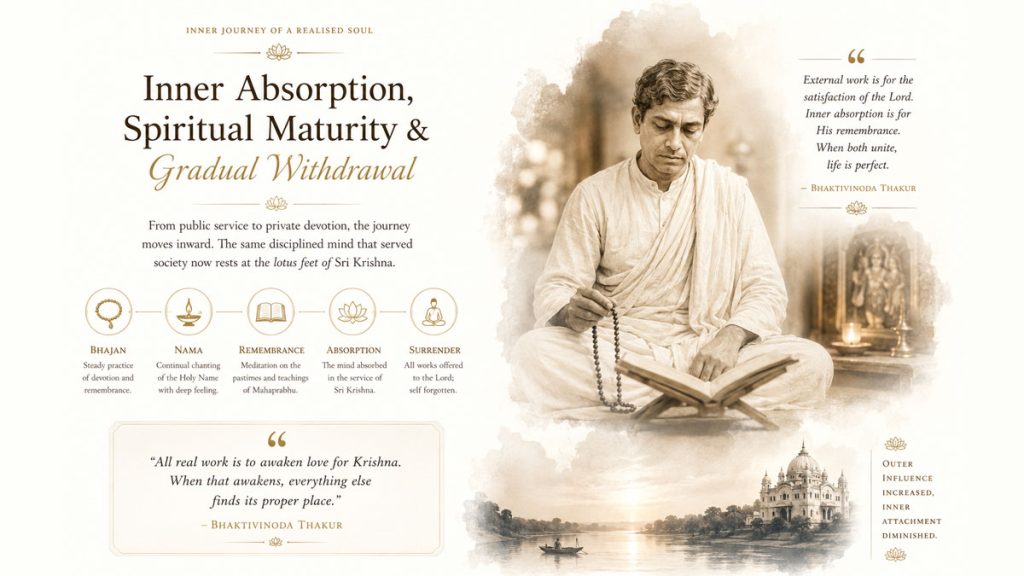
Inner Absorption, Spiritual Maturity & Gradual Withdrawal
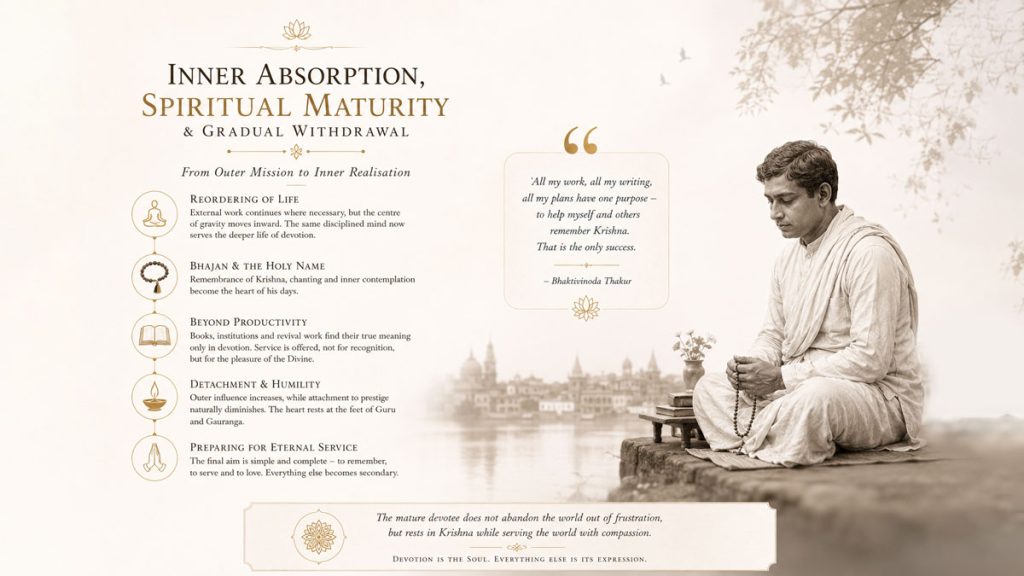
The mature Bhaktivinoda cannot be understood only as a public reformer, writer or organiser. The later movement of Saptam Goswami increasingly directs attention toward the interior dimension of his life. Public achievements remain important, but they are no longer the centre. Bhajan, the Holy Name, remembrance and spiritual absorption come more clearly into view.
This development gives balance to the entire biography. A modern reader can easily admire Bhaktivinoda for productivity: books written, institutions encouraged, sacred places recovered, public work completed. Yet the book ultimately points beyond productivity. All of these activities derive their deepest meaning from devotion.
The transition is therefore not from ‘active’ to ‘inactive’ life in a simple sense. It is a reordering of emphasis. External work continues where necessary, but personal ambition recedes. The centre of gravity moves inward. The same disciplined mind that once handled administration and public debate is increasingly absorbed in the inner life of bhakti.
For the website, this section should slow the visual pace. Earlier sections can be more informational and dynamic; here the design may become quieter, with fewer images, more space and perhaps a devotional quotation. The visitor should feel that the biography is moving from public history toward spiritual conclusion.
This phase also clarifies that Bhaktivinoda’s missionary work was never merely an intellectual project. His authority came from the convergence of thought, practice and devotion. The author who could speak to modern society was also a practitioner seeking deeper surrender.
The more historically influential he became, the less personal worldly importance mattered. This paradox is one of the most beautiful lessons of his later life: outer influence increased while inner attachment to prestige diminished.
Did You Know ?
The book’s closing atmosphere presents the outer mission and inner bhajan as two sides of one mature devotional life, not as competing identities.
The Seventh Goswami
(1910–1914)
Final Years, Departure & an Enduring Gaudiya Legacy
By the final years of his earthly life, Bhaktivinoda Thakur’s contribution had become extraordinarily broad. He had lived as Kedarnath the student, the householder, the government officer and the intellectual seeker. He had also become Bhaktivinoda the theologian, editor, author, preacher, organiser, guardian of Navadvipa Dham and deeply absorbed Vaishnava.
Saptam Goswami does not close his story as though a biography ends when a body disappears. The final pages are concerned with continuity. His books remain. The devotional understanding he articulated remains. The revived importance of Navadvipa and Mayapur remains. The missionary confidence he helped establish passes into the next generation.
This is the correct place for the website to explain why later devotees could regard him as the ‘Seventh Goswami.’ The title is not simply an honorific expressing affection. It points to a historical function. In a modern age of print, colonial administration, intellectual doubt and social transformation, Bhaktivinoda helped perform a work of preservation, systematisation, recovery and transmission that echoes the earlier service of the Goswamis.
The testimony reproduced near the conclusion of the book is especially moving because it emphasises the apparent impossibility of his life. He is remembered as a deeply religious man while also carrying the responsibilities of an officer, magistrate and large household. The witness marvels that he still found so many ways to serve the Supreme Lord.
That observation gives the biography its final human meaning. Bhaktivinoda’s greatness is not only that he produced extraordinary works. It is that he gradually turned the many compartments of an ordinary human life into service. Education became service. Writing became service. Administration became disciplined duty. Family responsibility became part of spiritual practice. Historical research became service to the dham. Communication became preaching.
For the final website panel, the best conclusion is therefore not merely a date of departure, but a statement of continuing influence: Bhaktivinoda helped carry the spiritual inheritance of Sri Chaitanya Mahaprabhu across the threshold of the modern world and prepared the conditions for its later global expansion.
“He was a very pious and religious man—he was given extra religious work.”
Did You Know ?
The testimony near the book’s conclusion specifically marvels that Bhaktivinoda maintained serious spiritual service despite his official duties and large family responsibilities.


